Sustainably Living the Activist Life part 6: Unseen Labor
Here in the northern hemisphere, spring has finally arrived, and not a moment too soon. This past winter was long in so many ways. Watching the scenes from frigid Minnesota of citizens braving subzero temperatures to stand up for their communities in the face of the brutal assault of ICE was both heartbreaking and motivating.
Each time ICE invades one of our cities, we learn things and we share that knowledge so that the next community that is targeted has more information and is better able to protect its citizens.
One of the things that struck me most powerfully in Minnesota was how much unseen labor went into defending their neighbors. People drove their neighbors' children to school, people provided food for those afraid to leave their homes to shop, people opened their cafés and gave away food and drink to keep protesters warm, people paid rent for those unable to safely go to work. And these acts of service and love haven't stopped simply because the ICE presence is reduced. Not gone, mind you — there are still about 1,000 ICE agents in MN — but reduced from the 3,000 there at the height of the assault.
The media has moved on, but the community hasn't.
We have been conditioned to focus on the big event or the person who's the face of a movement or a moment. But there is so much work that happens way behind the scenes, work without which there would be no movement or moment.
One of the tasks of our time is to break that habit of only acknowledging the headliner, only seeing the star, while failing to recognize how many people there are doing their unheralded bit that makes the work of the star possible.
If we look around at our own lives, we can identify the people and their various roles, their differing archetypes. The focus this month is on bringing the unseen labor and those who perform it to the fore. Not simply to acknowledge them, though that is important, but also to recognize that those in the spotlight don't do things solely on their own. We are working to build strong, resilient communities, and that doesn't happen without all roles being filled and all contributions being appreciated, including yours.
Where are you on the scale of seen vs. unseen labor? If you're more on the seen end, you likely get acknowledgment for the contribution you are making. If you're tilted towards the unseen end of that spectrum, it is more likely that your contribution is not readily recognized. This isn't about scorekeeping; it's about recognizing that there is so much that happens beyond our conscious notice and that each bit of effort moves us closer to the goal of building strong, vibrant, and resilient communities.
Let's take a look at how creativity, ritual, and commitment come into play in bringing awareness to the unseen labor performed by so many in our communities, often including us.
Creativity:
Again, it can be easy to miss all the unseen labor that people perform — it's called "unseen" for a reason. Truthfully, many of us don't want to be the focus of attention. We just want to do what we can and not bring notice to ourselves. That's cool. We each get to do our activist work in the way that makes the most sense for us. And it's still good to have awareness of all the pieces that keep the work moving forward and the people doing that work.
Take some time this month to create a visual representation of your group or a campaign you're working on. What are some of the invisible roles? For example, who keeps the group calendar updated? Who is printing out material for your meetings or creating the PowerPoint slides? If your group has an office space, who's keeping the bathroom stocked with toilet paper and the kitchen stocked with tea and coffee? Who cleans up after meetings?
Create a visual ecosystem of your group or campaign, and highlight the invisible roles to bring a more focused awareness to all the behind-the-scenes work that makes it possible to accomplish the group's goals.
Be sure to include yourself in this map. Often we do a lot of unseen labor but brush it off as nothing. If you wouldn't say it was nothing if someone else were doing it, it's not nothing.
Ritual:
This is super simple and deeply meaningful. Make it a habit each week to acknowledge and/or check in on someone doing an unrecognized task. We all want to feel that what we are doing matters, and someone expressing gratitude lets us know that what we are doing is, in fact, seen and appreciated.
Invite your group to recognize the unseen laborers in some way. It doesn't have to be anything big; a batch of cupcakes as a thank-you goes a long way.
Commitment:
Take on or redistribute one back-end task: child care, transportation, emails, food, meeting minutes, or follow-up, to name a few.
Doing anything over and over can become tedious. Some people like the stability of fixed tasks, but don't assume that. Check in and see if redistributing the work would rejuvenate an individual or the group as a whole. Often, fresh eyes can bring new and better ways of doing our work. But even if we maintain our current systems, shifting tasks from time to time can keep people from feeling burned out.
I want to close this by saying that yes, there is a lot of craziness in the world right now and it can feel overwhelming, but we are making progress. We have had more success in pushing back against this autocratic regime than we likely would have predicted a year ago. And a lot of that progress is due to unseen labor by probably hundreds of thousands of people, if not more.
We keep doing the work, we keep building bridges and stronger communities, and we keep doing the next right thing. That's how we achieve our goal of a society where everyone gets to live a life of dignity.
Sustainably Living the Activist Life (part 5)
Our theme for this month is JOY! Joy and ritual. Joy and creativity. Joy and commitment.
I don't know when I started signing off many, if not most, of my emails with an exhortation to joy, but it's been one of the most consistent things because joy is so powerful.
If you've been in this community for a while, you know that I am a huge fan of the Olympics and Paralympics. I will wake up at 4 a.m. to watch a favorite event. I've loved the Olympics as far back as I can remember watching them, and, for me, one of the big draws is the joy.
From the opening ceremony to the final moments, we get to witness people doing what they love, and have dedicated so much of their young lives to, on the world's biggest stage. The overwhelming majority know that they will not win a medal, and it does not matter. They are there.
Watching U.S. figure skater Alysa Liu perform her long program was 4 minutes of transcendent joy. Liu, who had won multiple national championships, retired from the sport at 16 because she wasn't having fun, the joy was gone. In her return, 2 1/2 years later, medals were no longer her goal. Her skating since her return is, quite simply, joyful. She has said that she skates because she loves it and because it's where she shares her artistry with the rest of us.
At the end of what was a truly magical performance, she skated off the ice and said, with a huge smile on her face, "That's what I'm fucking talkin' about."
Joy. That kind of delight is available to each of us if we'll just let ourselves have it.
Ritual:
Make it a practice to include things that bring you joy into your life on a regular basis. It doesn't have to be anything big; it can be a cup of cocoa and a book in your favorite genre. It could be reading to your kids, or someone else's kids. It could be hitting the skating rink and pretending you're Alysa Liu, and just reveling in the joy of gliding along the ice.
What you do doesn't matter. What matters is that you do something and that you consciously acknowledge the joy. We can run by things so quickly that we miss some of the best parts of our lives. Be present to the joy. We humans are hardwired to notice what isn't working. Noticing what is takes practice, and it's so worth the effort.
Creativity:
This is a great month to make something like a "joy in the resistance" playlist, collage, zine, or poem. The point here is to enjoy yourself. Maybe you decorate home-baked cookies with something inspiring or subversive.
Perhaps you gather a group of friends and make beach art with found objects, driftwood, sea grass, or shells, stating a core belief.
During the height of the AIDS epidemic, activists said that they "buried their friends in the morning, protested in the afternoon, and danced all night." In a terrifying time, they made a point of staying connected to their joy.
I believe joy is part of our birthright as humans. Sorrow comes round often enough; joy is there to remind us of what's beautiful in life and keep us pointed towards a better future.
Commitment:
Choose joy as a practice, not a luxury. Choose joy because you deserve it and because there's no longevity in the work of change-making without it.
Commit to whatever ritual for joy that you create. Bring others into it as much as makes sense. Joy is great by ourselves and magnified when others are part of it.
If you want to experience the power of collective joy, watch Alysa Liu's free skate.
Remember, joy is your birthright, stay connected to it!
Until next month,
Omkari
Sustainably Living the Activist Life (part 4)
I began writing this on January 20th, exactly one year from the start of the second term of he who shall go nameless. As bad as I knew it was likely to be, this year has been worse than I expected and horrifying in ways that I failed to imagine. I didn’t envision the cold-blooded murder, in broad daylight, of people who had previously been pretty much off limits before, white people. There is a particular kind of horror that is felt when the previously safe become targets and all pretense is stripped away as the evil doers stand in their places of power and lie to our faces about things we’ve clearly seen with our own eyes.
What has gotten me through, what I believe has gotten all of us through, is relationships and community, and that is what I want to talk about this month.
I’m currently reading this massive book, Resistance by Halik Kochanski. It’s about the resistance movements that sprung up in response to Hitler and his occupation of countries during WWII. It’s a fascinating account of the incredible ways in which people responded to what was happening. There are themes that I’m seeing that have relevance for us now.
The main ones, so far, are that people were incredibly creative in the ways they opposed the occupiers and, crucially, they built networks. Effective resistance was a group effort. People who would otherwise have nothing to do with one another built networks in support of a shared cause. They didn’t need to even agree on why they were doing what they were doing. For instance, some of those helping Allied personnel evade capture and escape the occupied countries did it as an act of resistance, others felt it was their humanitarian duty and didn’t think of themselves as resisters at all. And yet, they worked together on a common cause.
We can learn from this. Too often, in recent years, we’ve applied “purity” tests to others. They either had to agree with us 100% or risk being “canceled.” That was never a great way to engage with other people, and it’s completely counter productive now. We need to be strengthening our relationships with people and building trust. James Baldwin said, “We can disagree and still love each other unless your disagreement is rooted in my oppression and denial of my humanity and right to exist.” With that caveat, we need to find our way across differences to the shared goal and focus on that without worrying about some fantasy of purity that really only exists in our minds. In reality, do we even want to only be around people who think exactly as we do? Where’s the opportunity for growth, for expansion, in that scenario?
Another thing that those WWII resisters did was to keep evolving. If something didn’t work, they would try it a different way; they’d try new things; they’d work with what they had to create paths to success. From filling the frame of a bicycle with forged documents to get people across borders, to women and girls putting coded messages on the ribbons they used to tie up their hair, people got creative. They were committed to their cause, and they weren’t going to be deterred by the first, or fiftieth, setback.
So, as we move into this next year of the regime, as we witness the escalating brutality, one of our responses has to be to build stronger, broader, and deeper networks that support us all as we do the work of resistance.
Ritual:
Among the rituals that we’re building into our lives, including a check-in ritual with one other person or your group is critical. We’re all going to process what’s happening in different ways and at different times, and it can be easy to not realize that someone is struggling unless we make a point of checking in. I have regular check in calls set up with a couple of friends. They’re on my calendar, and they really help keep me tethered when the world feels like it’s spinning off its axis.
Who can you have as your check-in team? Make a decision and make a plan. You don’t want to wait until you’re desperate; a buddy or a team can help keep desperation at bay.
Creativity:
Whether we consider ourselves predominantly visual perceivers/learners or not, I think it’s important to be able to see the connections in our lives. Creating a map of those connections can be so satisfying. Being able to look at a sheet of paper and see who’s who in my life is grounding in and of itself. Who are the people I work with, the people I support, learn from, need to reconnect with? Also, seeing the connections often sparks ideas for other connections that can be made.
Explore creating a visual representation of the people in your world. You could print out some photos and paste their faces onto your map: your work colleagues, your ride or dies, your family, your neighbors, your teachers (whether you know them in real life or not), and those you want to know. It’s like a vision board of your community, and you can keep adding to it as your community grows. Post it where you can see it often. Let it remind you that you are far from alone. Let it inspire you to deepen the connections you have and expand into new connections. They don’t all have to be deep; just knowing your neighbors names makes a difference.
Commitment:
Successful movements are made of people, not social media posts. Posts can help, but they’re not the glue that keeps movements together. The Montgomery Bus Boycott lasted over a year without IG. The people who refused to ride the bus had a lot of differences, as we all do, and one shared goal. They focused on that goal and didn’t allow themselves to be pulled off it by outside pressure. When they were feeling weary, they turned to each other to keep the boycott going. They sacrificed to achieve their goal. Walking in the heat of an Alabama summer is no joke; neither are the extra hours it added to a work day. People made sacrifices, individually and collectively. And, critically, they made themselves accountable to each other.
Who are you accountable to? Who do you need to reconnect with? Are there people you can bring into the work? Have there been rifts that you may need to repair in service of a larger goal?
There is so much to be done, who can you ask to help with packing food for families afraid to leave their homes? Who has graphics skills that can be used to make posters about our rights that you can post around town? Who can join you in doing a bake sale to raise funds for a mutual aid fund? Who can be an ear for you, and for whom can you be an ear?
When people are asked why they sit on the sidelines in times like these, the most common answer is that no one asked them to join in. Invite people in.
Whatever your skill set is, there is something that you can do. If you are struggling to find your way of making a contribution, check out this list on my website.
We all know that it is tough out there, and every single day people in Minneapolis, Chicago, LA, and elsewhere around the country are proving that, together, we are tougher than the federal forces aligned against us.
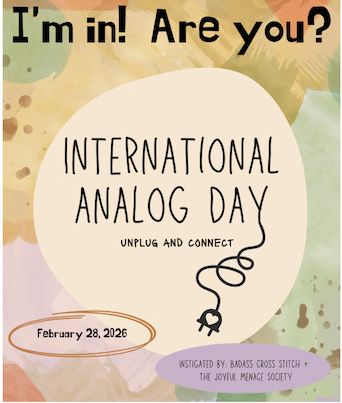
Next month I'll be talking about JOY! Because even in the darkest times we can, and must, find it. Speaking of joy, let me remind you that the inaugural International Analog Day (IAD) is on February 28th. The brainchild of my friend Shannon Downey, IAD is meant to get us off our devices and into community. You can design the day anyway you want. This is a perfect time to deepen and expand community. You can learn all about it here.
Until next month,
Omkari
Sustainably Living the Activist Life part 3
Wow! Another year nearly in the books. So many of my friends and I have the same sort of whiplash feeling of a year that flew by overall, but really dragged in the relentless attacks on our admittedly imperfect democracy.
As the year ends and we're looking towards the new year, it's important to think about what we're bringing with us, what we want to ditch, and how we structure our lives so that we can fulfill the commitments we've made to others and ourselves. How can we lean into our ritual practices to help us stay grounded in the midst of chaos, and into the creative practices that keep us connected to our joy?
Commitment, Ritual, and Creativity are like the legs of a stool, take one leg away and we're on the floor. To do our work in this world, whatever that work may be, we are most able to respond rather than react, and are at our strongest, when we take care of the whole of ourselves. It's easy to burn out in the face of so much injustice and deep harm, but that does not serve the people and causes we care about.
That brings us to our theme for January: Start Focused, Not Frantic.
So, how might we enter 2026 to best be set up for making the impact we wish to make? We get focused. Focus starts with clarifying our commitment. When I was in acting school, on the very first day in fact, my teacher told us that specificity was everything. He put it this way, "You couldn't get home if you didn't know that was where you were going." Um, yes. I've thought about this often over the decades since then. Knowing where we want to go is essential. Til we have directional clarity we kind of just wander around being pulled this way and that by whatever voice is loudest.
It's really easy to get pulled off our main thing when so much bad is happening, but letting ourselves go from one thing to another without guardrails around our energy and capacity isn't the most effective use of our limited, by virtue of being human, resources. It's focus that helps keep us from feeling frantic. It's focus that let's us address the next right thing to do, and then the next, rather than bouncing around.
What are you committed to in 2026?
You don't even need to consider the whole year if that feels unrealistic, just look at the first quarter. Where, from January through March, will you put the bulk of your efforts? If you're feeling obligated to respond to current events, because ICE, I want to remind you that there are a lot of other things going on that also need our attention. You will be most impactful when you follow your heart in terms of the work you choose to do. That heart connection will help keep you going when things get rough. What issue, group, or practice is your heart asking you to commit to this quarter? Not what you think you "should" do, but what you're actually called to do.
And remember, this is not written in stone. If something dramatic happens to shift your focus that's fine. The point isn't to make a rigid commitment, but to make one that feels right for you, and to articulate it to yourself so that there's clarity about what you are doing.
And this isn't limited to the U.S.; no matter where you are in the world, this is a challenging time. There are so many people suffering because of the actions of a grotesquely wealthy, amoral, and powerful few. I believe that our best way to fight back is to build strong communities–communities that are responsive to the needs of their members.
Over the past few decades we've been led to believe that our individual success was the highest goal we could attain. We were turned away from the notion that we are our neighbors keepers. But we are. That has always been true and we are now seeing the cost of having forgotten that foundational truth.
As we move into this New Year let's commit to reestablishing "I am my neighbor's keeper" as a core driver of our behavior.
If we have a few core principles and keep our promises, both to others and ourselves, realistic, then commitment becomes just part of how we live and doesn't require herculean efforts when most of us are already feeling stretched thin. Directing our attention helps reduce the pressure.
We know what is and, as importantly, what isn't ours to do.
As I say repeatedly, there are around 8 billion people on planet Earth. If we each did something about the one or two causes that are most important to us, we'd have it all covered.
Ritual:
This time of year I like to hunker down and do cold climate winter things. Things that feel restorative in the short, dark days of the season. I read more, including re-reading favorite books. I take walks when the snow is falling, and more long baths and hot chocolate. More quiet time and Gregorian chants. Long chats with friends and naps, definitely more naps. I even have different workout habits, more Pilates and Barre and less time on the elliptical or in a step class. I cook in big batches and share with my neighbors.
For me, winter is about grounding myself. It's the time when I find it easiest to envision my goals for the year ahead. It's the season that I feel best fits my internal rhythms. Slow, steady, deep.
What is your experience of the season you're experiencing? Are there rituals that you find yourself practicing without necessarily even noticing? What practices can you intentionally bring into this season that will set you up well for the year ahead?
A new ritual that I will be practicing starting in 2026 is International Analog Day (IAD). The brainchild of my friend Shannon Downey, IAD is about disconnecting from our devices and reconnecting with people. This first IAD falls on Saturday, February 28th and you can find out all about it and how to participate here.
I'm thinking that I'll host an ice skating cocktail party. No, we won't be drinking while we skate, that sounds like a trip to the Emergency Room waiting to happen. First the skating, then the cocktails and hot chocolate. I'm looking forward to putting down the devices and kicking it old school. Knowing that other people around the world are joining in and doing their own version of IAD, perfect!
Creativity:
What creative practices are fueling you right now? I am not someone naturally gifted in the visual arts, so my creativity emerges in other ways. I knit, I cook, I write. I sing at the top of my lungs anything from Broadway show tunes to Joan Baez. I'm learning to make zines and, for the ones I want to reproduce and distribute, I'm roping in my artistically inclined friends to do the drawings for me.
Here's a spin on New Year resolutions, you could make a zine with your vision for the quarter (or the whole year) mapped out. You could put benchmarks for things you want to accomplish in there and then color them in as the year goes along. At the end of the year you would have a personal map of all you've done. Actually, I really like this idea, I'm going to give it a go. This feels better to me than resolutions, which I don't do, way too easy to beat oneself up when we fail to meet our own unreasonable standards!
Something I think is important is to recognize that creativity is not only part of our birthright as humans, it's also necessary to our mental well-being. Creativity uses different parts of our brains than strategic, logical work. Ideally, in doing our creative projects we get into a state of flow where time disappears and we're just doing our thing, whatever that might be. We've been trained to be on the "productivity" bandwagon for so long that it can be easy to forget that there is more to life than being "productive". It can be easy to forget that being productive actually feels best when that's not all we're doing. Constant productivity feels like a slog. Productivity mixed with creativity and play–that feels like a good life.
What creativity can you bring into this upcoming year? How can you best support yourself to express yourself?
Let me close this by saying that I am so proud of us. We have weathered a truly challenging year and we are still here, committed and fighting for the world we want to see. As the year comes to a close let's celebrate all that we've done in the face of huge obstacles. As we look forward to 2026 let's hold on to our communities and our joy. Isn't that what we're fighting for really?
I'll see you in 2026! Happy New Year everyone!
Love, love, love,
Omkari
Sustainably Living the Activist Life: Rest (pt. 2 of 12)
As we ramp up into the holiday season and wind down the year there is a lot pulling at us. At the end of a long and tumultuous year what we all use is rest. All too often we don’t think of rest as part of our practice of activism but I believe we should. Without rest we can’t function properly. This is as true in our activist work as in any other area of our lives.
But what does meaningful rest look like? I think there are multiple elements to meaningful rest. There is the rest of our bodies, of course, but there is also the rest of our minds and our spirits. I’m pretty sure that you’ve had days when your soul is just exhausted. Crushed beneath the weight of the injustice in the world.
In this season that is meant to be about celebrating and giving thanks for the blessings in our lives we can easily get off track. Pulled by the pressure to consume and to outdo the Joneses we can find ourselves more depleted by the end of December than we were at the beginning.
This year my challenge to all of us is to do things very differently. To create some new, non-consumer driven traditions, and to think about the role of rest in our lives and our activist work. To make a plan for incorporating rest into our regular schedule so that we have what it takes to keep showing up.
Let’s look at each of our pillars in the context of rest.
Let's start with Commitment:
December is the perfect time to put pressure on the powers that be by opting out of our consumer driven holiday culture.
Here’s a little story for you, many years ago I had a friend whose father was a famous entertainer. The family was quite wealthy and could easily afford lavish holiday gift giving and celebrations. But there was a rule, no purchased Christmas gifts. Gifts were exchanged, but they had to be made. The kids and the parents made gifts for one another. That had a couple of impacts including that there weren’t a ton of gifts under the tree. When you’re making things by hand there’s a natural limit to what is possible.
When my friend told me about this I remember being so surprised. At first it felt like they were somehow losing out on Christmas but then, as I thought about it, I realized how beautiful that tradition was. I thought about how much more likely they were to remember the gifts they’d been given. How they would certainly remember the gifts they made. And I saw how beautiful that truly was.
This season we are being asked to restrict our consuming (specifically boycotting Target, Amazon, and Home Depot) as part of a larger plan to save our democracy from those who are selling us out to put more money in their already bulging pockets.
Let's face it, we have been trained to consume. I recall George W. Bush telling us, in the immediate aftermath of September 11th, to go shopping. Shopping. As if that was somehow going to ease the pain of the hole in the sky outside my window where the Twin Towers had been.
Resistance history is replete with stories of people withholding their financial participation in a corrupt system and forcing change. From the Salt March in India in 1930, the Anti-apartheid Movement boycotting Shell Oil, to the Montgomery Bus Boycott from Dec. 5, 1955 - Dec. 20, 1956, economic mass actions have changed oppressive systems for the better.
As we gear up to what I believe will be a mass economic blackout of large businesses in the U.S. (likely sometime next year) we can practice by restricting our spending at the time of year when these businesses make the bulk of their money. We can make, swap, and buy local. We can gift experiences rather than things. We can use cash rather than credit to keep more dollars in our local businesses and out of the hands of big banks.
I am going to shop for gifts, but I’m going to do my best to avoid feeding the machine. I’m going to check out thrift stores. I’m going to shop locally and pay with cash. I love my town’s winter market where local artists sell their creations. I’m going to see what I’ve got that can be gifted (if I’m not using it and it will bring someone else joy, that works for me). And, I’m going to shop keeping this handy rhyme in mind. “Something they want, something they need, something to wear, something to read.” I don’t do all four for anyone, and two gifts is my max for children. We don’t need to teach them to be mindless consumers. Everyone gets a book, socks are also a go to for me. Cozy socks and a book = bliss.
We can rethink how we do things, despite the ways in which we’ve been trained to feed the machine.
How does all of this relate to rest? So much of the stress in our lives is economic. There is so much pressure to be seen in a certain way, with certain things that confer status. Opting out of that paradigm is deeply restful. Not incurring unnecessary debt is restful. Not having a home full of stuff we wanted for a minute and then forgot about is restful. Keeping more of our money and being more intentional in our spending is restful. Basically, getting off the hamster wheel of automatic consumption is restful.
And, in a time when so many Americans are facing extreme financial stress due to job cuts, the high cost of living, and exploding health care costs, spending less, and mindfully, creates more peace of mind. And peace of mind is a deeply restful state.
Next up, ritual.
Here in the northern hemisphere it is winter, and I love winter. I love the quiet that comes with snowfalls, I love the coziness of thick socks and sweaters. I love the time to be more inwardly directed as the days are short and cold. I appreciate that in the slowing down I have more space to think, to plan, to reflect without the impulse to get out and enjoy the beautiful weather.
Winter invites us to create rituals that are restorative by their very nature. The soothing cup of hot chocolate, the jigsaw puzzle, the book that’s been sitting on your coffee table waiting for you to pick it up, the craft projects that got little attention over the busy warm weather months.
Setting up these rituals to transition us out of urgency and into restoration now, in the quieter time, means that when the busier seasons again arrive we will already have practices of restoration in place.
Maybe it’s a long, hot bath. Perhaps you set up a regular call with a friend who lives far away. I have a monthly call with a dear friend and it always gives me the experience of resetting. I often find that, in explaining what is going on in my life to her, that I gain increased clarity about things that have been swirling in my brain. You may find that a regular meditation practice is what you need. Maybe solitary walks in nature without listening to anything but the sounds around you.
Whatever means you choose, the point is to move into a steadier, more tranquil internal experience.
Lastly, creativity.
Being creative uses a different part of our brain than when we’re just being analytical. Being creative releases endorphins. Being creative brings us joy. What can you make in this season that’s become so caught up in excess? Doesn’t have to be something big, one Christmas I burned a CD for my dad of different covers of one of his favorite songs. He loved that gift, and I loved making it for him.
When I’m using my creative muscles, no matter how tired I am at the end, there is an experience of being restored in a deep way.
Turning to creativity in a season that has become so stressful for so many of us is a reclaiming of our spirit, a reclaiming of the true meaning of the season, and a rebuke to the culture of consumerism.
This year let’s opt out of pouring our money into coffers of those who have demonstrated time and again that their profit, not our well-being, is their highest concern. Let’s exercise our imaginations and creativity to craft a season that isn’t about how much money we spend but how much joy and connection we can create.
Measured spending, experiences over things. Creativity and play over consuming.
We can create beautiful, joyful, restful holidays without the pressure and expense that has become so normalized. We can set ourselves up to enter the New Year refreshed not exhausted. We can use this season to begin to create the habits of rest that will help us sustain our activist work over the long haul.
We are deserving of beautiful lives, and the beauty of those lives is to be found in the experiences we have far more than the things we have. So let’s reset. Let’s dial down the consumption and ramp up the connections, to our family and friends, to our communities, to ourselves.
Happy holidays!
Sustainably Living the Activist Life
This is the first post of 12 dedicated to a year in the activist life. Each month will explore a different theme and include thoughts and suggestions for incorporating Commitment, Ritual, and Creativity into your activism as a way of making this work sustainable over a lifetime, not just a moment.
In conversations with a number of people in the work of activism I’ve heard something that has been concerning. People are reporting that engagement with the day to day work of change making has been falling off. Fewer people taking regular action even as things spiral further into fascism. Honestly, I’m not entirely surprised. These past 9 months have been a lot. And, for a lot of people, it’s felt overwhelming. Believe me, I get it.
I also know that these are people who would be horrified to wake one day and realize that their lack of action contributed to things being even worse than they are with even more irreparable damage having been done.
So, I started thinking about what I could do to address this and what I’ve decided is that over the next 12 months (starting this November) I’m going to cover the elements I have found to be essential in sustainably living the activist life.
It’s not like breathing, we weren’t born knowing how to do this. While some of us were taught early at our parent’s knee, others of us came to the work later, when we woke up to the injustice and harms of our systems. Whenever you entered the work, what matters is that you are here now — when we desperately need the contributions of all people of conscience.
As we push back against rising fascism there is intense pressure to respond to the threats and the assaults. And this is when we need to remember that this isn’t a moment, it’s a movement. A movement towards true democracy, true justice. That means that we have to sustain what we’re doing over the long haul.
Movements require care and attention, they need a culture that lets them grow and adapt, but first they need to know what their aim is, individually and collectively.
The purpose of this series is to give you strategies throughout the next 12 months that will help you stay grounded, bring others into the work, and keep showing up. Commitment, Ritual, and Creativity, are the tools we’ll be using.
If you’re new to the work, my intention is to give you an onramp that makes it easy for you to add your contribution. If you’ve been in the work for a while I hope that you’ll use these thoughts as a way of fine tuning what you’re doing and how you’re doing it so as to avoid burnout.
My plan is to guide you, one piece at a time, to help you to, if you’re starting from scratch, design a rhythm, or, if you’ve been in the work for a while, tweak what you’re doing, so that you can show up sustainably — not constantly.
I’m going to be working within the context of three pillars, Commitment, Ritual, and Creativity. Let me start by defining what these pillars mean to me in the context of activism.
Commitment is what keeps movements going. Not constant urgency about everything, but clarity about what you are willing and able to do and showing up with consistency to do that thing, whatever it may be. You consistently show up to do the email notifying people about what’s going on every week, and you build trust which builds power and momentum. The same is true for whatever role you choose to take on. Demonstrate commitment and watch what a difference that makes.
Movements are sustained not by constant urgency, but by clarity, care, ritual, and creativity. Commitment means finding your lane and staying in it, trusting that when others do the same, with millions of people in the work, we’ve got it all covered. Commitment builds trust, power, and momentum.
Ritual is about having an anchor. Rituals ground us. They create structures that help us stay resilient, give us time for reflection, correction, and adaptation. They are touchstones we can regularly return to in order to not be blown off course by the chaos, of the moment.
For some it’s their faith or spiritual practice, for others it’s a practice like daily journalling, dedicated time in nature, or time disconnected from devices and spent in the analog world. It could be a regular coffee date with a friend or going to a movie, listening to live music, playing music. What it is, is completely up to you. The point is to create a practice that reconnects you to your deeper self. A practice that gives you respite from the stresses of the world so that you can return to the work restored.
Creativity is about joy! It helps us stay connected to the world we are working to build. Creativity pushes back against narrowing of our options that dictators seek to impose on us. Your creative practice isn’t about how good you are at it, it’s about how much pleasure it brings you. Sure, your art can be used in the movement, but the main purpose is so we don’t forget what we’re fighting for. So crochet, knit, paint, needlepoint, draw, dance, sing, write a poem, a story, or a protest song. Cook, make pottery, write a limerick, arrange flowers, hook a rug, make a joyful noise, make a zine. Maybe you create a space for others to be creative in.
Whether as a solitary pursuit or a communal one, the idea is to bring something that gives you joy into the world with no regard for how “perfect” it may or may not be. I, for example, can’t draw well, but collage? Man, I’m a wizard with a stack of magazines, a pair of scissors, and a glue stick.
Our inaugural theme for sustaining the activist life is Clarifying Your Role and Finding Your Rhythm.
Commitment is about getting clear about your values, the cause you want to support. and your role in the work.
In my book, Micro Activism, I talk about the Activist Archetypes. The Headliner, the Producer, the Organizer, and the Indispensable. You can find the archetype quiz here and find your archetype. Once you do that identifying your role in the work becomes much more straightforward.
When your capacity and your actions match, sustaining your activism becomes much easier. Trying to force yourself into a role that simply isn’t you is a sure way to burn out and drop out. Recognizing that we need the contributions of all types of people to successfully change our systems means that you can show up exactly as who you are.
Commitment Action prompts:
Make a list of your skills, capacities, available time and energy.
Ask: Where do I want to put my energy? Protecting democracy, environmental issues, women’s reproductive rights? You can’t do it all, pick one and focus. You can always move on to something else later but try to commit for at least a year to give yourself time to gain traction.
Ask: What does the movement I’m working with need that I can provide based on the above?
Name your role. The role you can fill right now. Our roles change over time and that is as it should be, so don’t worry about a year from now. Just identify where you are today and what contribution you can make.
Ritual Action Prompts:
Personal: What personal ritual can you adopt as a regular practice?
Collective: Each week, make it a practice to check in with yourself, ask:
What did I say yes to?
What felt energizing? What felt draining?
Based on this: What do I want to do more of? What do I want to say no to this week?
Creativity Action Prompts:
Make a list of creative practices you would enjoy including in your life.
Pick one and play.
Remember it’s about joy, not proficiency. If you get better at what you do, that’s a bonus, it’s not the goal. The goal is to reconnect with that part of us that is willing to dive in for the sheer pleasure of the moment and the creative endeavor at hand.
That's it! I hope that this feels as exciting and nourishing for you as it does for me. Next month's theme is Rest. Look for that email in your inbox the last week of November. Until then, reach out with questions or feedback. And please, do share this widely. We need as many people in this work as we can get!