I began writing this on January 20th, exactly one year from the start of the second term of he who shall go nameless. As bad as I knew it was likely to be, this year has been worse than I expected and horrifying in ways that I failed to imagine. I didn’t envision the cold-blooded murder, in broad daylight, of people who had previously been pretty much off limits before, white people. There is a particular kind of horror that is felt when the previously safe become targets and all pretense is stripped away as the evil doers stand in their places of power and lie to our faces about things we’ve clearly seen with our own eyes.
What has gotten me through, what I believe has gotten all of us through, is relationships and community, and that is what I want to talk about this month.
I’m currently reading this massive book, Resistance by Halik Kochanski. It’s about the resistance movements that sprung up in response to Hitler and his occupation of countries during WWII. It’s a fascinating account of the incredible ways in which people responded to what was happening. There are themes that I’m seeing that have relevance for us now.
The main ones, so far, are that people were incredibly creative in the ways they opposed the occupiers and, crucially, they built networks. Effective resistance was a group effort. People who would otherwise have nothing to do with one another built networks in support of a shared cause. They didn’t need to even agree on why they were doing what they were doing. For instance, some of those helping Allied personnel evade capture and escape the occupied countries did it as an act of resistance, others felt it was their humanitarian duty and didn’t think of themselves as resisters at all. And yet, they worked together on a common cause.
We can learn from this. Too often, in recent years, we’ve applied “purity” tests to others. They either had to agree with us 100% or risk being “canceled.” That was never a great way to engage with other people, and it’s completely counter productive now. We need to be strengthening our relationships with people and building trust. James Baldwin said, “We can disagree and still love each other unless your disagreement is rooted in my oppression and denial of my humanity and right to exist.” With that caveat, we need to find our way across differences to the shared goal and focus on that without worrying about some fantasy of purity that really only exists in our minds. In reality, do we even want to only be around people who think exactly as we do? Where’s the opportunity for growth, for expansion, in that scenario?
Another thing that those WWII resisters did was to keep evolving. If something didn’t work, they would try it a different way; they’d try new things; they’d work with what they had to create paths to success. From filling the frame of a bicycle with forged documents to get people across borders, to women and girls putting coded messages on the ribbons they used to tie up their hair, people got creative. They were committed to their cause, and they weren’t going to be deterred by the first, or fiftieth, setback.
So, as we move into this next year of the regime, as we witness the escalating brutality, one of our responses has to be to build stronger, broader, and deeper networks that support us all as we do the work of resistance.
Ritual:
Among the rituals that we’re building into our lives, including a check-in ritual with one other person or your group is critical. We’re all going to process what’s happening in different ways and at different times, and it can be easy to not realize that someone is struggling unless we make a point of checking in. I have regular check in calls set up with a couple of friends. They’re on my calendar, and they really help keep me tethered when the world feels like it’s spinning off its axis.
Who can you have as your check-in team? Make a decision and make a plan. You don’t want to wait until you’re desperate; a buddy or a team can help keep desperation at bay.
Creativity:
Whether we consider ourselves predominantly visual perceivers/learners or not, I think it’s important to be able to see the connections in our lives. Creating a map of those connections can be so satisfying. Being able to look at a sheet of paper and see who’s who in my life is grounding in and of itself. Who are the people I work with, the people I support, learn from, need to reconnect with? Also, seeing the connections often sparks ideas for other connections that can be made.
Explore creating a visual representation of the people in your world. You could print out some photos and paste their faces onto your map: your work colleagues, your ride or dies, your family, your neighbors, your teachers (whether you know them in real life or not), and those you want to know. It’s like a vision board of your community, and you can keep adding to it as your community grows. Post it where you can see it often. Let it remind you that you are far from alone. Let it inspire you to deepen the connections you have and expand into new connections. They don’t all have to be deep; just knowing your neighbors names makes a difference.
Commitment:
Successful movements are made of people, not social media posts. Posts can help, but they’re not the glue that keeps movements together. The Montgomery Bus Boycott lasted over a year without IG. The people who refused to ride the bus had a lot of differences, as we all do, and one shared goal. They focused on that goal and didn’t allow themselves to be pulled off it by outside pressure. When they were feeling weary, they turned to each other to keep the boycott going. They sacrificed to achieve their goal. Walking in the heat of an Alabama summer is no joke; neither are the extra hours it added to a work day. People made sacrifices, individually and collectively. And, critically, they made themselves accountable to each other.
Who are you accountable to? Who do you need to reconnect with? Are there people you can bring into the work? Have there been rifts that you may need to repair in service of a larger goal?
There is so much to be done, who can you ask to help with packing food for families afraid to leave their homes? Who has graphics skills that can be used to make posters about our rights that you can post around town? Who can join you in doing a bake sale to raise funds for a mutual aid fund? Who can be an ear for you, and for whom can you be an ear?
When people are asked why they sit on the sidelines in times like these, the most common answer is that no one asked them to join in. Invite people in.
Whatever your skill set is, there is something that you can do. If you are struggling to find your way of making a contribution, check out this list on my website.
We all know that it is tough out there, and every single day people in Minneapolis, Chicago, LA, and elsewhere around the country are proving that, together, we are tougher than the federal forces aligned against us.
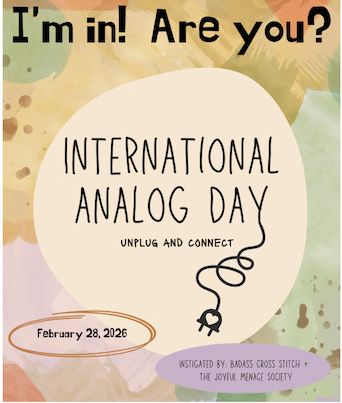
Next month I'll be talking about JOY! Because even in the darkest times we can, and must, find it. Speaking of joy, let me remind you that the inaugural International Analog Day (IAD) is on February 28th. The brainchild of my friend Shannon Downey, IAD is meant to get us off our devices and into community. You can design the day anyway you want. This is a perfect time to deepen and expand community. You can learn all about it here.
Until next month,
Omkari